New pre-print on epidural focused ultrasound for neuromodulation!
We are excited to share a new preprint demonstrating our miniaturized epidural focused ultrasound (eFUS) technology for deep-brain neuromodulation in awake and freely moving animals.
Focused ultrasound offers a unique way of reaching deep structures in the brain without the penetrating electrodes traditionally used for deep-brain stimulation. However, current approaches rely predominantly on transcranial ultrasound delivered using external transducers, making them less suited to applications requiring repeated or chronic stimulation.
In this work, together with our collaborators, we take a different approach: bringing ultrasound directly to the surface of the brain.
At the heart of the system is a miniaturized two-dimensional piezoelectric transducer array directly integrated with a custom ASIC. The resulting epidural ultrasound interface can electronically steer and focus ultrasound at software-defined locations deep inside the brain, without mechanically moving the device.
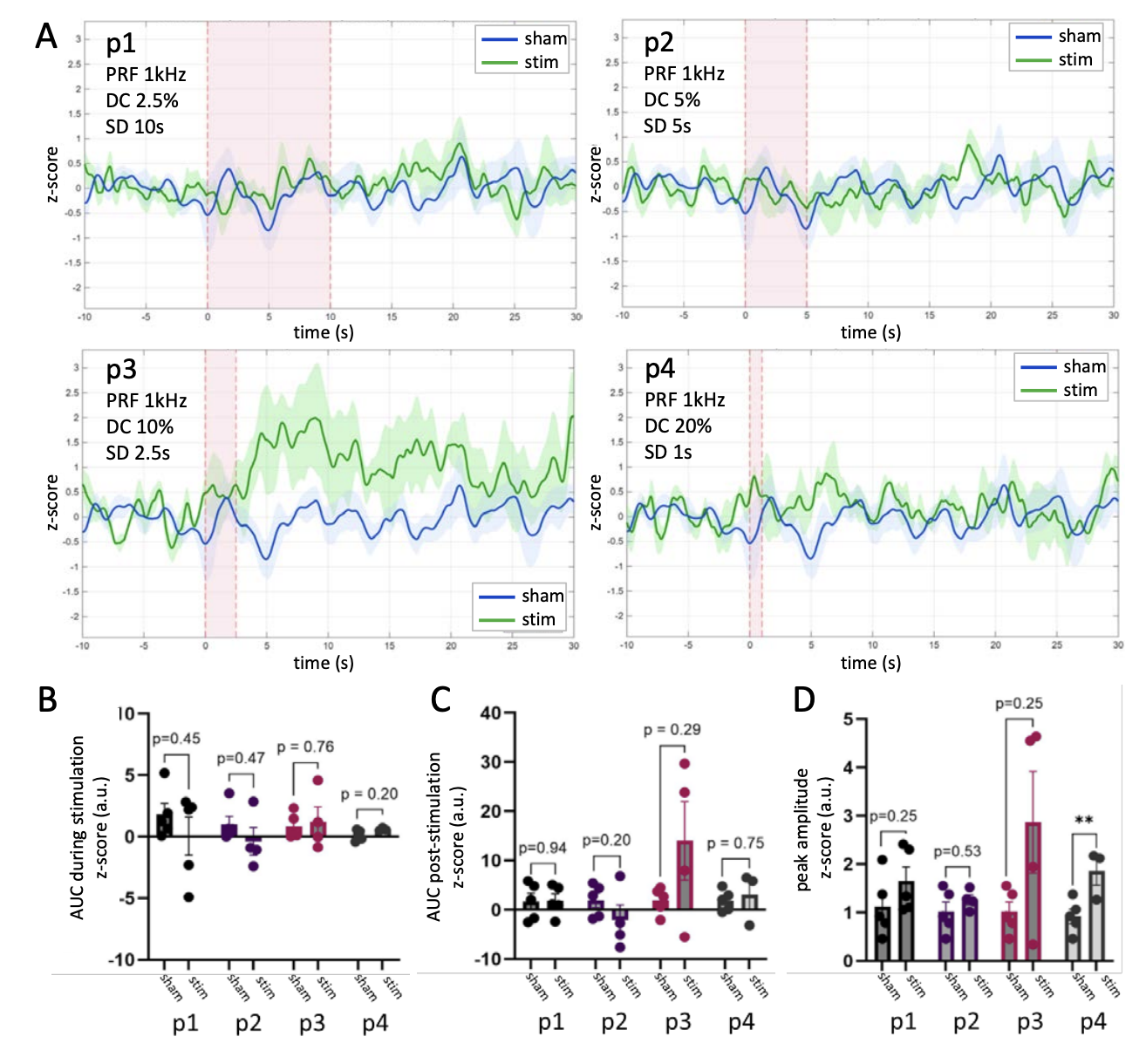
After characterizing its focusing and steering capabilities in vitro, we tested the system in awake, freely moving rats. By electronically targeting the ventral tegmental area (VTA), a deep-brain structure involved in the brain’s reward circuitry, ultrasound stimulation produced a measurable increase in dopamine release in the nucleus accumbens, recorded using fiber photometry.
For us, this represents an important step towards a new class of minimally-invasive ultrasound interfaces: microsystems capable of addressing different locations deep inside the brain electronically, while remaining at its surface.
This achievement was the result of a major collaborative effort across several years and disciplines within UPSIDE, our EIC Pathfinder project funded by the European Union (under Grant Agreement No. 101070931).Lisa Ratz and Mate Dobrossy led the in vivo work that enabled us to take the eFUS technology from the laboratory into freely moving animal experiments. On the technology side, Hassan Rivandi, Gandhika K. Wardhana, Eshani Sarkar, Masoumeh Aqamolaei and Samuel Desmarais contributed to the development of the eFUS chip and system across its different stages, from the underlying integrated electronics and transducer technology to the final experimental platform. A huge thank you also goes to all the other co-authors, whose contributions and fruitful discussions throughout the four years of the UPSIDE project helped us get this far.
The preprint, “An electronically steerable epidural ultrasound interface for deep brain neuromodulation in freely moving rats,” is now available on bioRxiv.
We are currently preparing the manuscript for submission to a top-tier journal. Stay tuned!